
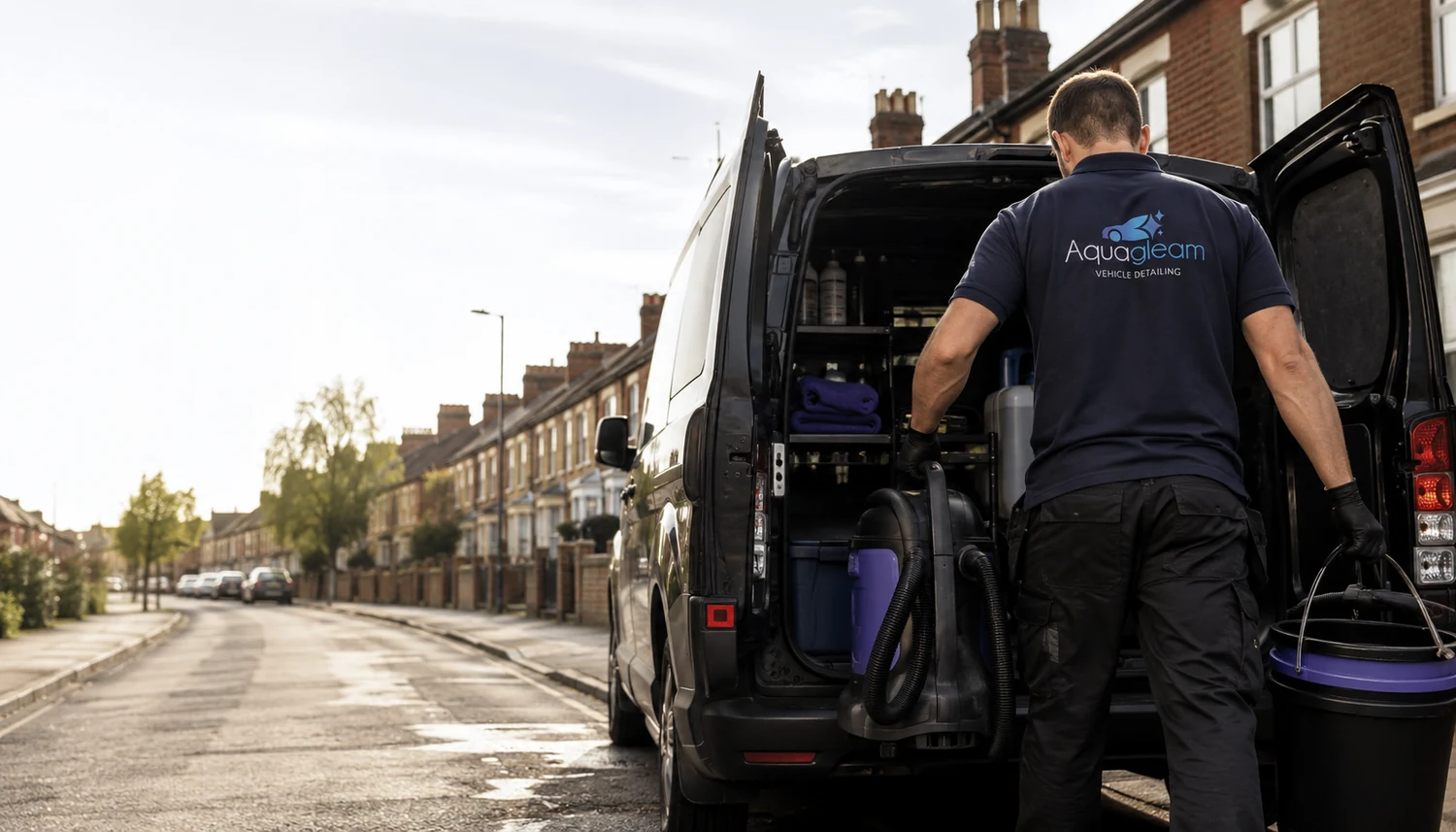
Starting a mobile car detailing business in the UK takes anywhere from under £400 to about £1,600 of kit, insurance that covers customers' cars as well as the public (roughly £350–£800 a year), and registering with HMRC as a sole trader. This guide walks through every decision — from kit and insurance to pricing, first customers, VAT, and the systems that stop the admin eating your evenings.
Mobile car detailing is one of the cheapest skilled trades to start in the UK. You don't need a unit, you don't need staff, and you don't need a fancy van. What you do need is a clear set of decisions made early so you don't end up undercharging, uninsured, or buried in WhatsApp messages by month three. This guide covers each of those decisions in the order they actually matter.
What is a mobile car detailing business?
In the UK, a mobile car detailing business is a service operation where the detailer travels to the customer's location — their home, workplace, or a commercial site — and cleans, restores, or protects their vehicle on-site. It's distinct from a fixed-location detailing studio (where customers bring their cars to a unit) and from a hand car wash (which sits at the lower-cost, higher-volume end of the market).
"Detailing" in the UK trade now broadly means the higher-skill, higher-margin end of vehicle cleaning — paint correction, ceramic coatings, full interior restoration, fabric protection — rather than the basic wash-and-vac that's traditionally been called "valeting." The two terms overlap in customer searches but signal different price points and skill levels in the trade. Most UK businesses now describe themselves as detailers because it positions them above the hand car wash market and lets them charge accordingly.
If you're starting at the wash-and-vac end and building up from there, the guide to starting a mobile valeting business is written from that angle. This one covers the detailing route.
Quick reference
- Country
- United Kingdom
- Trade category
- Mobile vehicle services / automotive detailing
- Starter kit
- Under £400 lean; £500 – £1,600 fuller
- Insurance (public + customers' cars)
- £350 – £800/year
- Self-employed registration
- HMRC sole trader (free)
- VAT registration threshold
- £90,000 rolling 12-month turnover
- Making Tax Digital
- Turnover over £50,000 now; £30,000 from April 2027; £20,000 from April 2028
- Realistic gross earnings (solo)
- £40,000 – £70,000/year
1. Decide your legal setup: sole trader or Ltd
Almost every new mobile detailer in the UK starts as a sole trader. It's free to set up, the admin is light, and you keep all the profits after tax. You register with HMRC for self-assessment, file an annual tax return, and pay income tax and Class 4 National Insurance on your profits. Class 2 isn't charged once your profits reach £7,105 a year; it's treated as paid, so your National Insurance record is still protected.
A limited company gives you legal separation between you and the business, can be more tax-efficient at higher profit levels (where that point sits depends on your numbers and how you pay yourself, so ask an accountant to model it), and looks more credible to commercial customers. The trade-off is more admin: you need to file annual accounts at Companies House, run payroll if you pay yourself a salary, and likely pay an accountant £400–£1,200 per year to handle it.
Most detailers start sole trader and switch later. There's no penalty for doing it that way.
2. Sort insurance before you take a single booking
Insurance is the one thing you can't start without, and the cheapest policy is often the wrong one. Most new detailers need two kinds of cover:
- Public liability covers injury to other people and damage to their property: a customer tripping over your hose, or overspray landing on the neighbour's car. Most solo detailers start with a £1 million limit.
- Cover for the car you're working on. Many public liability policies exclude the vehicle in your care, so a pad that burns through the clear coat, or a chemical that stains a dashboard, isn't covered. Ask for customers' vehicles cover (often called care, custody and control) and check the limit per car.
As a guide, public liability on its own starts at about £68 a year, while a combined policy that also covers customers' vehicles is roughly £350–£800 a year for a sole mobile operator. If you'll ever drive a customer's car on a public road, even for a few metres, you also need road risks cover under a motor trade policy. Your own van needs business use on its motor policy, and your kit needs cover against theft.
Get two or three quotes from brokers who insure detailers and valeters, and tell them exactly what you do, especially machine polishing and coatings.
Full guide: car detailing and valeting insurance in the UK: what cover you need and what it costs.
3. Buy the right starter kit (without overspending)
The temptation when you're new is to buy everything. Don't. The kit you actually need to start is small. Here's a realistic starter breakdown for the UK:
| Item | Typical cost (UK) |
|---|---|
| Pressure washer (Karcher K2–K5 or equivalent) | £100 – £300 |
| Snow foam lance + foam | £30 – £60 |
| Wash mitts, drying towels, microfibres | £40 – £100 |
| Wheel brushes + iron remover | £30 – £60 |
| Vacuum (wet/dry, 1200W+) | £60 – £200 |
| Interior cleaning kit (APC, glass cleaner, brushes) | £40 – £100 |
| Polisher (DA — if doing correction work) | £100 – £400 |
| Water tank or portable supply (if no customer access) | £50 – £200 |
| Branding (van decals, business cards, basic uniform) | £50 – £200 |
| Total realistic starter | £500 – £1,620 |
You don't need every item from day one. Plenty of detailers start with a pressure washer, a vacuum, basic chemicals, and one set of microfibres — total under £400 — and add equipment as bookings come in. Insurance is a yearly cost on top of the kit (see step 2). Reinvest from your first ten or twenty jobs rather than maxing a credit card on day one.
Full guide: Equipment for UK mobile car detailers: starter kit guide (2026).
4. Price your services (and stop undercharging)
The single most common mistake new UK mobile detailers make is pricing too low. You're not competing with hand car washes — they sell volume at low prices, you sell quality at fair prices to a different customer.
Realistic UK pricing benchmarks for a solo mobile detailer:
- Maintenance wash: £40–£80, depending on vehicle size and region
- Full exterior + interior detail: £120–£250
- Single-stage paint correction: £250–£450
- Two-stage correction + ceramic coating: £500–£1,200
- Interior deep clean (no exterior): £80–£180
Pricing should also vary by vehicle size. A Range Rover takes longer than a Mini, uses more product, and the customer expects to pay more. Don't charge the same flat rate for both — build vehicle-size pricing into your services from day one.
Full guide on how to price car detailing services in the UK available now.
5. Find your first customers
The early customers come from three places: people who already know you, local visibility, and the booking experience itself.
Start with your network. Friends, family, colleagues, anyone with a car. Charge them — mates' rates if you must, but charge them. Free work doesn't generate referrals; paid work does. Ask for a Google review the moment they pay.
Local visibility means a Google Business Profile (free, mandatory), an active Instagram showing actual jobs (before/after photos), and presence in local Facebook community groups where rules allow. Avoid mass-spamming. One genuine post a week beats ten promotional ones.
The booking experience matters more than people realise. If your booking process is "DM me on Instagram and I'll get back to you when I can," you're losing customers who'd rather book at 11pm on a Tuesday than wait. A simple online booking page with deposit collection turns enquiries into confirmed jobs while you're working on someone else's car.
Full guide on getting your first 100 detailing customers available now.
6. Register with HMRC and understand your tax basics
If you're trading as a sole trader, you need to register for self-assessment with HMRC by 5 October following the end of the tax year you started trading. So if you started in May 2026, you must register by 5 October 2027. Don't leave it.
You'll pay income tax on your profits (revenue minus allowable expenses) and Class 4 National Insurance (6% on profits between £12,570 and £50,270 in 2026–27, then 2% above that). Allowable expenses include fuel for business mileage, equipment, products, insurance, phone and internet share, accountant fees, and a portion of home utilities if you use a home office. Keep receipts and use simple accounting software from day one.
Making Tax Digital for Income Tax is the change to plan for. Instead of one return a year, you keep digital records and send HMRC quarterly updates through compatible software. It already applies to sole traders whose turnover (before expenses) was over £50,000 in 2024–25. The threshold drops to £30,000 from April 2027 and £20,000 from April 2028, so most full-time detailers will be in it within a couple of years. If your records are digital from the start, the switch is painless.
You don't need an accountant in year one if your numbers are simple, but most detailers find one in year two or three saves them more in tax than they cost.
7. Know when to register for VAT
VAT registration becomes mandatory once your rolling 12-month taxable turnover exceeds £90,000. For most solo mobile detailers, that's a year-three or year-four problem, not a day-one one. But you need to track turnover monthly so you don't miss the threshold and trigger penalties.
Voluntary registration sometimes makes sense earlier — particularly if a meaningful share of your customers are VAT-registered businesses (commercial fleets, dealerships, body shops) who don't care about the 20% you'd add because they reclaim it.
Full guide: VAT for UK Mobile Detailing Businesses (2026 Guide).
8. Mobile vs fixed location: making the call
Mobile is cheaper to start, more flexible, and reaches customers who can't or won't bring their car to a unit. The trade-offs: weather dependency, water and power access challenges, and a real cap on how many jobs you can fit into a day because of travel time.
A fixed-location studio costs more to start (typical UK unit rent is £400–£1,200/month plus utilities and business rates) and requires customers to come to you. But it eliminates travel time, lets you work in any weather, and supports higher-skill work like ceramic coating and paint correction that benefits from controlled lighting and dust-free conditions.
Most successful UK detailers start mobile, build a customer base for 1–3 years, then either move to a unit or go hybrid (unit base for premium work, mobile for maintenance customers).
Full guide on mobile vs fixed location for UK detailers available now.
9. Build the systems before you need them
Most detailers underestimate how much time admin takes once you're past five jobs a week. Booking via WhatsApp, chasing deposits over bank transfer, sending reminders by hand, tracking customer details in your phone notes — it works for the first month, then breaks.
The systems that actually matter for a UK mobile detailer:
- Online booking: customers pick a service, choose a date, pay a deposit, get a confirmation. No back-and-forth.
- Deposit collection: a customer who's paid something up front is far less likely to cancel late or not be in.
- Automated reminders: a text or email the day before catches the customers who've simply forgotten.
- Customer records: vehicle make/model, last service date, postcode, notes (water access, gate code). Build a real database, not WhatsApp threads.
- Branded booking page: your name, logo and services, not a generic scheduling link.
You can stitch this together yourself with five or six tools, or use one platform built for the workflow. Either way, sort it out before month three, not month nine.
Booking software for UK car detailing businesses
DetailBook gives you your own booking page, a calendar, and customer records that keep every vehicle's details, so bookings stop living in WhatsApp. Built in the UK, for detailers.
See how DetailBook works →10. Common mistakes new UK detailers make
- Underpricing. Charging hand-car-wash rates for skilled work is the fastest way to burn out. You're not competing with them.
- Buying the cheapest policy. If it only covers public liability, the Range Rover bonnet you just burnt through is your bill, not the insurer's.
- Buying every product. A pressure washer, a vacuum, three good chemicals, and a stack of microfibres get you to your first hundred jobs.
- Doing free work for "exposure." Free work attracts customers who don't value the service and don't refer.
- WhatsApp-only bookings. Missed messages, double bookings and an evening of admin every day. Get a proper booking system before you scale.
- Not tracking turnover. Crossing the £90,000 VAT threshold without realising leads to backdated tax bills and HMRC penalties.
- No deposit policy. If a customer hasn't paid anything, they haven't really booked.
A realistic first-90-days plan
Days 1–14: register as a sole trader with HMRC, set up insurance, buy the minimum starter kit, build a one-page website (or a single booking page), open a dedicated business bank account.
Days 15–30: service five paying customers (friends, family, work colleagues), photograph every job, get five Google reviews, set up a Google Business Profile.
Days 31–60: systemise. Online booking with deposits live. Start posting weekly on Instagram. Reach out to one local fleet, taxi firm, or dealership about commercial work.
Days 61–90: fifteen paying customers minimum, fifteen Google reviews. Start charging proper rates. Drop free work entirely. Begin tracking rolling turnover.
Frequently asked questions
How much does it cost to start a mobile car detailing business in the UK?
Most people start with under £400 of basic kit: a pressure washer, a vacuum, a few good chemicals and microfibres. A fuller set-up with a polisher, water tank and branding is roughly £500 to £1,600. Insurance comes on top, at roughly £350 to £800 a year for a policy that covers customers' cars as well as the public.
Do you need a licence to be a mobile car detailer in the UK?
No. There's no licence to work as a mobile car detailer in the UK. You do need to register as self-employed with HMRC, have insurance that covers customers' cars as well as the public, and stop dirty water and chemicals running into surface-water drains, which can be a pollution offence. If you plan to work in a public street or car park rather than on customers' drives, check with the council, as some (particularly in London) treat that as street trading.
Should I register as a sole trader or a limited company?
Most new mobile detailers start as sole traders because it's free to set up and the admin is light. A limited company can become more tax-efficient at higher profits, or if you want legal separation between you and the business. Where the break-even sits depends on your numbers and how you pay yourself, so ask an accountant to model it before you switch.
How much can a mobile detailer earn in the UK?
It depends on your prices, your area and how many jobs you fit in. As a worked example, three or four jobs a day, five days a week, at an average of £55 to £75 a job comes to roughly £40,000 to £70,000 a year before costs. Correction and coating work raises the average job value but takes longer.
When do I need to register for VAT as a mobile detailer?
You must register once your VAT-taxable turnover goes over £90,000 in any rolling 12-month period, within 30 days of the end of the month in which you went over. Most solo mobile detailers stay below the threshold, but track your turnover monthly so you don't miss it.
Does Making Tax Digital apply to a new detailing business?
It will once your turnover is high enough. Making Tax Digital for Income Tax means keeping digital records and sending HMRC quarterly updates through compatible software. HMRC decides from your Self Assessment return: turnover before expenses over £50,000 in 2024 to 2025 means starting from April 2026, over £30,000 in 2025 to 2026 from April 2027, and over £20,000 in 2026 to 2027 from April 2028.
This article is general guidance for UK car detailing businesses and does not constitute legal, tax, or insurance advice. UK regulations and tax thresholds change. Always check the latest GOV.UK guidance, speak to a qualified accountant about your specific tax position, and get insurance quotes from regulated providers before starting to trade.