
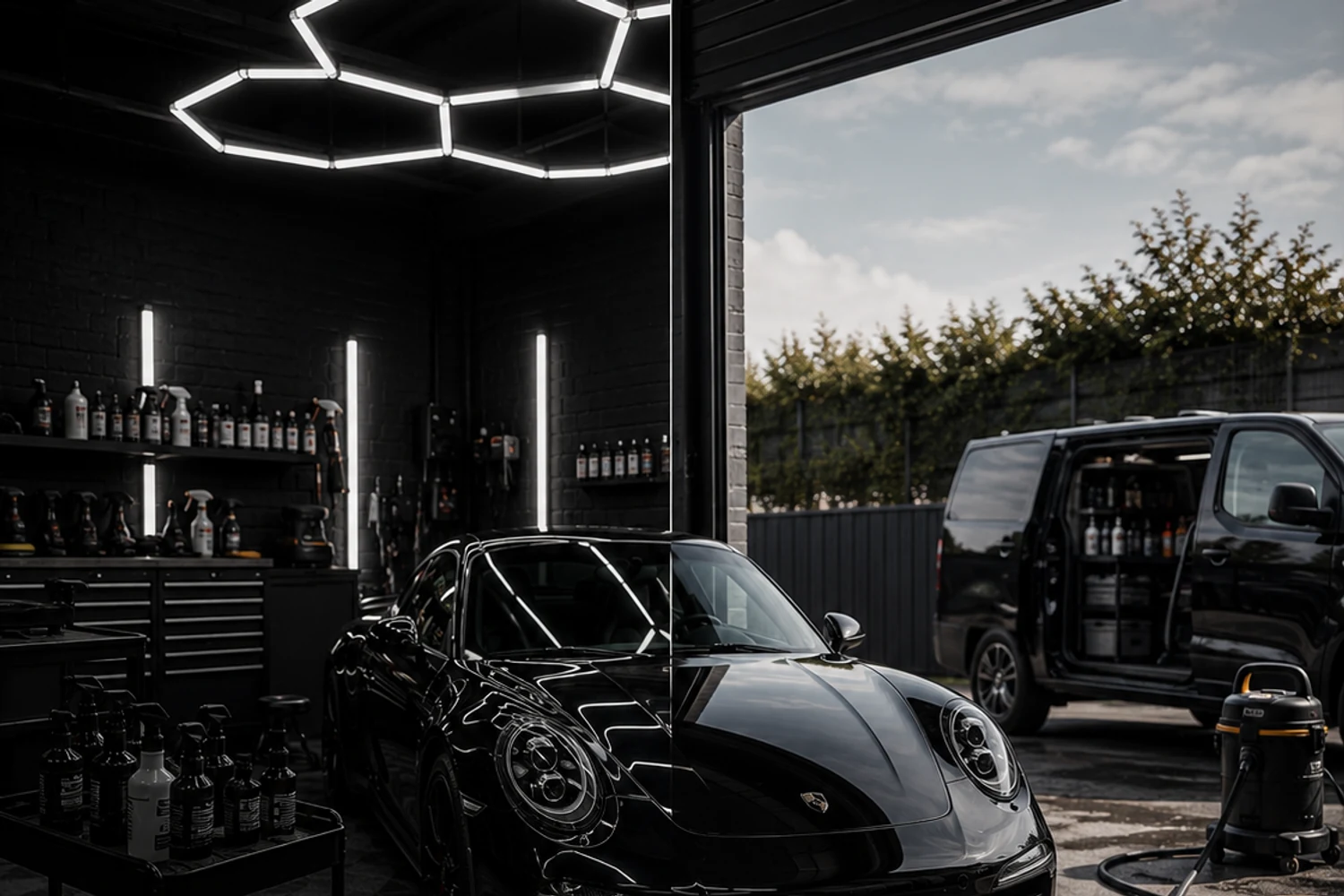
If you're thinking about starting a car detailing business in the UK, one of the very first decisions you'll face is this: do you go mobile, or do you set up in a fixed location?
It's a question I wrestled with myself a few years back. I chose mobile, built a solid business from it, and I haven't looked back. But that doesn't mean it's the right answer for everyone. Both models have genuine merits — and they're fundamentally different businesses with different costs, different challenges, and different lifestyles.
Let's break it down properly. No fluff, no theory — just the practical reality of each model so you can make the right call for your situation.
The Mobile Detailing Model
Mobile detailing is exactly what it sounds like: you go to the customer. You work from your vehicle, carry your equipment with you, and detail cars on driveways, car parks, and office forecourts. It's the model most new detailers start with, and for good reason.
Startup Costs
This is where mobile detailing really shines. You can realistically get started for £500 to £2,000 depending on what equipment you already own and how ambitious your initial setup is.
A basic mobile setup includes:
- Pressure washer (£80–£300)
- Wet and dry vacuum (£50–£150)
- Buckets, mitts, microfibre towels (£50–£100)
- Cleaning products — shampoo, APC, glass cleaner, tyre dressing (£50–£150)
- Polishing machine if you're offering paint correction (£100–£300)
- Water tank and 12V pump if customers don't have an outside tap (£100–£250)
You don't need a van on day one. Plenty of detailers start from the boot of their car and upgrade once bookings justify it.
Pros
- Low overhead — No rent, no rates, no utility bills for a unit. Your main ongoing costs are fuel and products.
- Flexibility — Work when you want, where you want. Take a Wednesday off or do six days a week. It's your call.
- Huge service area — You're not limited to people who happen to drive past your unit. You can cover an entire county.
- Customers love convenience — Most people would rather hand over their keys and go about their day than drop their car off somewhere.
- Start immediately — No planning permission, no lease negotiations, no fit-out period. Buy your kit and you're in business.
Cons
- Weather dependent — Rain, wind, and freezing temperatures can wipe out a day's work. British weather doesn't care about your schedule.
- Carrying everything — You're limited to what fits in your vehicle. Forget something and you're stuck.
- Travel time — Driving between jobs eats into your earning hours. A 45-minute drive between bookings is dead time.
- Limited water and power — Not every customer has an outside tap or convenient plug socket. You'll need to plan around this.
- Less control over your environment — Uneven driveways, nosy neighbours, dogs running through your wash water. You learn to adapt quickly.
🚀 Pro Tip
Invest in a portable water tank and 12V pump early. It removes the "do they have a tap?" problem entirely and opens up jobs at offices, flats, and car parks where there's no water access. A 400-litre tank with a decent pump costs around £200 and pays for itself within a week.
The Fixed Location Model
A fixed location means you have premises — a unit, garage, industrial arch, or even a spot on a dealership forecourt. Customers come to you, you work in a controlled environment, and you build a visible presence in one location.
Startup Costs
This is where it gets serious. Realistically, you're looking at £10,000 to £50,000+ to get a fixed location up and running, depending on where you are in the country and the state of the premises.
Typical costs include:
- Deposit and first few months' rent (£2,000–£10,000+)
- Fit-out — flooring, drainage, lighting, water supply (£3,000–£15,000)
- Equipment — extraction machines, compressors, lifts, polishing stations (£2,000–£10,000)
- Signage and branding (£500–£3,000)
- Insurance — premises, public liability, employers if you hire (£1,000–£3,000/year)
- Business rates (£500–£5,000+/year depending on location)
Pros
- Controlled environment — No weather worries. Consistent lighting, temperature, and workspace every single day.
- More equipment options — Lifts, extraction machines, paint thickness gauges on stands, dedicated polishing bays. You're not limited by what fits in a van.
- Walk-in trade — If you're on a busy road or industrial estate, people see you and walk in. Free marketing.
- Professional image — A branded unit with proper signage looks the part. Some customers feel more confident leaving their car at a business premises.
- Not weather dependent — Rain or shine, you're working. No lost days, no rescheduling.
Cons
- Massive overhead — Rent, rates, utilities, insurance. Your costs don't stop just because you have a quiet week.
- Rent and rates — Even a modest unit costs £500–£1,500/month before you've earned a penny. In London or the South East, double that.
- Limited to local area — Your customers need to be willing to drive to you. That's a much smaller catchment than mobile.
- Stuck if business is slow — With mobile, a slow week costs you very little. With a unit, a slow week still costs you rent, rates, and utilities.
- Commitment — Leases are typically 1–5 years. If the business doesn't work out, you're still on the hook.
🚀 Pro Tip
If you're set on a fixed location, look into shared units or subletting space from an existing garage or bodyshop. Some MOT centres have unused bays they'll rent out cheaply, and you get the benefit of their passing trade. It's a much lower-risk way to test the fixed model before committing to your own lease.
The Hybrid Approach
Here's something that doesn't get talked about enough: you don't have to pick one or the other.
Plenty of successful UK detailers run a hybrid model. The most common setups look like this:
- Mobile during the week, unit at weekends — You do maintenance washes and valets on customers' driveways Monday to Friday, then use your unit for bigger correction and coating jobs at the weekend.
- Mobile in summer, unit in winter — British winters are brutal for mobile work. Having a unit to retreat to from November to March keeps the revenue flowing.
- Start mobile, graduate to a unit — This is probably the smartest approach of all. Build your customer base and income mobile, then take on a unit when the demand is there to support it.
The hybrid model gives you the best of both worlds: low-risk income from mobile work and the professional setup of a unit when you need it.
🚀 Pro Tip
If you go hybrid, make sure your booking system can handle both types of work. You'll need different service durations, different pricing, and potentially different availability for mobile vs unit-based jobs. A good booking system lets customers choose the service type and shows appropriate time slots for each.
What Most Successful Detailers Actually Do
I've spoken to dozens of detailers across the UK who are earning a proper living from this trade. The pattern is remarkably consistent:
- They start mobile — Low risk, low cost, learn the trade while earning.
- They build a customer base — 50–100 regular customers, solid reviews, steady income.
- They specialise — Paint correction, ceramic coatings, PPF — the high-value work that justifies premium pricing.
- They move to a unit when demand supports it — Not because it looks cool on Instagram, but because the numbers make sense.
The detailers who struggle are usually the ones who lease a unit before they have the customers to fill it. A shiny new unit with no bookings is just an expensive place to sit and worry about rent.
Build the demand first. The premises can come later.
The Numbers
Let's get specific. Here's a realistic monthly comparison for a solo detailer in a mid-sized UK city, working five days a week:
| Mobile | Fixed Location | |
|---|---|---|
| Rent / Rates | £0 | £800–£1,500 |
| Utilities | £0 | £150–£300 |
| Fuel / Travel | £200–£400 | £50–£100 |
| Insurance | £40–£80 | £80–£250 |
| Products | £80–£150 | £100–£200 |
| Phone / Software | £30–£50 | £30–£50 (e.g. from £25/month) |
| Total Monthly Costs | £350–£680 | £1,210–£2,400 |
Now let's look at the earning side. Assume you're doing 3–4 jobs per day mobile, or 4–5 jobs per day fixed (no travel time), working 22 days a month:
| Mobile | Fixed Location | |
|---|---|---|
| Average job value | £80–£120 | £80–£120 |
| Jobs per day | 3–4 | 4–5 |
| Monthly revenue | £5,280–£10,560 | £7,040–£13,200 |
| Monthly costs | £350–£680 | £1,210–£2,400 |
| Monthly profit | £4,600–£9,880 | £4,640–£10,800 |
The numbers tell an interesting story. At full capacity, a fixed location can earn slightly more because you're not losing time to travel. But the profit margins are remarkably similar because the higher overhead eats into those extra earnings.
The critical difference is risk. If you have a quiet month as a mobile detailer, your costs barely change. If you have a quiet month with a unit, you're still paying £1,200+ in fixed costs regardless.
🚀 Pro Tip
Don't forget the hidden costs of a fixed location: business rates, waste disposal, water metering, building insurance, and maintenance. These add up quickly and can easily add another £200–£400 per month to your outgoings. Factor them in before signing any lease.
Which Should You Choose?
Here's my honest advice based on what I've seen work and what I've seen fail:
Choose mobile if...
- You're starting out with limited capital (under £5,000)
- You want to test whether detailing is actually for you before committing
- You value flexibility and don't want to be tied to a lease
- You're building this alongside another job and need to scale gradually
- You enjoy being out and about rather than stuck in one place
Choose fixed location if...
- You've got £20,000+ in capital and a solid business plan
- You already have a proven customer base that would follow you to a unit
- You specialise in work that requires equipment you can't carry (lifts, extraction bays, spray booths)
- You've found premises in a high-traffic location at a reasonable rent
- You're planning to hire staff and need a base of operations
Choose hybrid if...
- You want the security of mobile income with the capability of a unit
- You've been mobile for a while and want to add higher-value services
- You can find a shared or part-time unit arrangement to keep costs low
If you're genuinely not sure, start mobile. It's the lowest-risk option, it teaches you everything you need to know about running a detailing business, and if it doesn't work out, you're not left with a lease you can't get out of.
Tools You'll Need Either Way
Whichever model you choose, certain things are non-negotiable if you want to run a professional detailing business:
A proper booking system — Back-and-forth messaging on WhatsApp or Facebook is fine for your first few customers. But once you're doing 15+ jobs a week, you need an appointment booking system that handles bookings, collects customer details, and manages your diary automatically. Otherwise you'll spend your evenings doing admin instead of resting.
Payment processing — Cash is still common in valeting, but more and more customers expect to pay by card or online. Having a seamless payment system built into your booking process makes you look professional and means you're not chasing payments after the job.
Customer management — Knowing when a customer last booked, what car they drive, what services they prefer, and when they're due their next detail. This information turns one-off customers into regulars — and regulars are where the real money is.
Online presence — A booking page that customers can access 24/7. Whether it's 10pm on a Sunday or 7am before work, if someone decides they want their car detailed, you need to be bookable right then and there. Every hour you're not bookable is a potential customer lost to someone who is.
Built for Mobile Detailers, Wherever You Work
DetailBook gives you automated online bookings, customer management, built-in upsells, and custom intake questions — whether you're working from a van or a unit. Purpose-built for UK detailers who want to spend less time on admin and more time earning.
Try DetailBook Free for 14 Days →No credit card required • Cancel anytime
Whatever model you choose — mobile, fixed, or hybrid — the businesses that thrive are the ones that treat it like a proper business from day one. Get your systems right, deliver outstanding work, and the rest tends to follow.
If I had to start again tomorrow with nothing, I'd go mobile without a second thought. Low cost, low risk, high flexibility. Build the demand first, then let the business tell you when it's time to grow.
Good luck out there.
Starting your mobile detailing business? Read our guide on how to get your first 100 customers as a mobile detailer for practical strategies that actually work.
Need help setting your prices? Check out How to Price Your Car Detailing Services in the UK.
About DetailBook: Booking software for UK car detailing businesses — online booking, a calendar and customer records. Based in Rotherham, South Yorkshire.