
In the UK, valeting and detailing aren't the same thing — valeting refers to general car cleaning at £15–£80, detailing refers to higher-skill premium work (paint correction, ceramic coatings, deep restoration) at £150–£1,500. The terms overlap in customer searches but signal different price points and skill levels in the trade. This guide explains how UK detailers, customers, and search engines actually use the words — and which one fits your business.
Confusion between valeting and detailing is common, especially among customers. Most UK consumers grew up with "valeting" meaning the bloke at the petrol station who'd run a hand car wash for £6 while you got a coffee. "Detailing" is a more recent import — it's the term the trade has adopted for the higher end of vehicle care, borrowed largely from the US over the last 15 years. Both words are now in active use, and they don't mean the same thing. If you're starting a mobile car detailing business in the UK, knowing which term you fall under affects pricing, customer expectations, and how you market.
What "valeting" means in the UK
Valeting is the older, more consumer-familiar term. In UK usage, it traditionally covers basic vehicle cleaning — exterior wash, wheel clean, vacuum, dashboard wipe-down, glass cleaning. Sometimes a tyre dressing or quick polish. The work is fast (typically 30 minutes to 2 hours), uses standard products, and is priced as a volume service.
Typical UK valeting price points:
- Hand car wash (forecourt): £6–£15 for a basic exterior wash and tyre dressing.
- Mini valet (mobile or fixed): £25–£45 — wash, vacuum, glass, basic interior wipe.
- Full valet: £50–£100 — deeper interior, dashboard treatment, dressing, exterior protection wax.
Valeting is what most UK consumers search for when they want their car cleaned. Search volume for "mobile valeting near me" or "car valeting" in the UK consistently outperforms equivalent detailing terms, particularly outside premium-vehicle areas.
What "detailing" means in the UK
Detailing emerged as a distinct category in the UK trade roughly 10–15 years ago, imported from the US enthusiast community. It refers to higher-skill, higher-margin work where the result — not just the cleanliness — is the product.
Detailing typically includes:
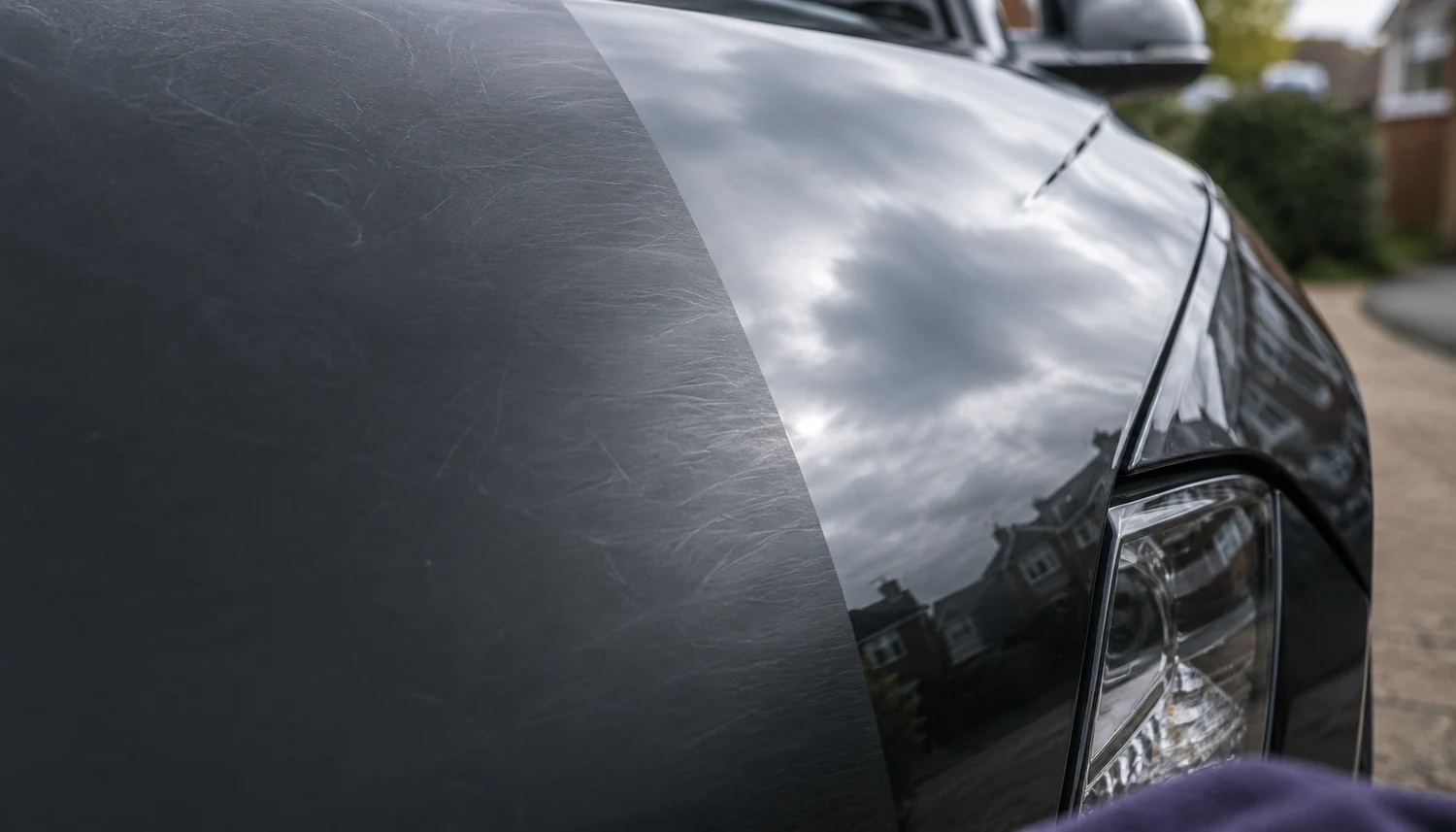
- Paint correction: machine-polishing to remove swirl marks, scratches, and oxidation, restoring clarity and gloss.
- Ceramic coatings: applying a chemical coating that bonds to paint to provide multi-year protection. Brands like Gtechniq, GYEON, Carbon Collective, and Auto Finesse dominate the UK market.
- Deep interior restoration: steam cleaning, leather treatment, fabric extraction, odour removal.
- Concours-level finishing: meticulous wash, decontamination, two- or three-stage polishing, ceramic protection. Often takes 2–5 days.
Typical UK detailing price points:
- Full detail (interior + exterior, no correction): £120–£300.
- Single-stage paint correction + protection: £250–£500.
- Two-stage correction + ceramic coating: £600–£1,500 depending on coating durability and vehicle size.
- Concours / show prep: £1,000–£3,000+.
Detailing customers tend to be enthusiasts, owners of premium or prestige vehicles, or buyers preparing a car for sale. They expect specific products, specific techniques, and visible results — and they'll pay accordingly.
Side-by-side: valeting vs detailing in the UK
| Factor | Valeting | Detailing |
|---|---|---|
| Typical price range | £15–£80 | £150–£1,500+ |
| Time per job | 30 min – 2 hrs | 3 hrs – 5 days |
| Skill level | General cleaning, low barrier | Trained, with paint correction and ceramic application skills |
| Equipment | Standard wash kit | Polishers, machine pads, ceramic coatings, premium products |
| Typical customer | General public, busy households | Enthusiasts, prestige owners, vehicle resellers |
| Search volume (UK) | Higher (consumer term) | Lower but growing, higher intent |
| Margin | Volume-driven, lower per job | Higher per job, fewer jobs needed |
Which should you call your UK business?
The answer depends on what you actually do, not what sounds more professional.
If your work is primarily wash, vacuum, and quick interior turnaround at £25–£80 per job, calling yourself a "valeter" or "mobile valeting service" is honest and matches what your customer base searches for. You'll appear in "mobile valeting near me" searches and won't disappoint customers who arrive expecting basic cleaning.
If you offer paint correction, ceramic coatings, or are pricing at £150+ per job, "detailer" is the right fit. The term signals what customers are paying for, attracts the right type of customer, and positions you above the hand-car-wash market.
Many UK businesses sit in between and use both: "Mobile valeting and detailing" or "professional valeting and detailing services." This captures both audiences and reflects the reality that most UK trade businesses offer a sliding scale of services.
Why the trade has shifted toward "detailing"
Three reasons.
One, "detailing" sounds higher-skill. The hand car wash market has driven valeting prices down and made the term feel commodity. Detailers wanted clear water between themselves and a £6 forecourt wash. The terminology shift was a positioning move.
Two, the products and techniques really did change. Paint correction with dual-action polishers, ceramic coatings, ph-balanced shampoos, two-bucket method, decontamination chemistry — these came from the US enthusiast scene and arrived in UK trade discourse with the word "detailing" attached.
Three, training providers, suppliers, and trade publications use "detailing" as the umbrella term. UK Detailing Academy, Auto Finesse Academy, supplier websites, detailing forums (Detailing World, Autopia UK), and the trade press all use "detailing" rather than "valeting." If you're in the trade, "detailer" is what your peers call you.
What this means for marketing
Practical implications for a UK business.
- Use both terms in your marketing copy. Customers search "valeting"; the trade uses "detailing." A page titled "Mobile valeting and detailing" captures both.
- Don't undersell yourself by calling premium work "valeting". Pricing follows positioning. If you do correction and coatings, position yourself as a detailer.
- Don't overstretch by calling basic work "detailing". If a customer pays £200 expecting paint correction and gets a wash and wax, you've burned the relationship.
- City pages, Google Business Profile, and meta descriptions should match what real customers in your area search for. A premium-area business may convert better as "detailing"; a price-sensitive area better as "valeting."
- Internally, you're a UK car detailing business when it comes to identity and structured data. This is the positioning that differentiates you from the hand car wash market and supports premium pricing across your service mix.
Booking software for UK car detailing businesses
DetailBook gives you your own booking page, a calendar, and customer records that keep every vehicle's details, so bookings stop living in WhatsApp. Built in the UK, for detailers. Works for valeting, detailing, or both.
See how DetailBook works →This article is general industry guidance for UK car detailing and valeting businesses. Pricing, terminology usage, and customer search behaviour vary by region and over time. The figures and trends here reflect typical UK 2026 market conditions.